
MUX Distribution Valve

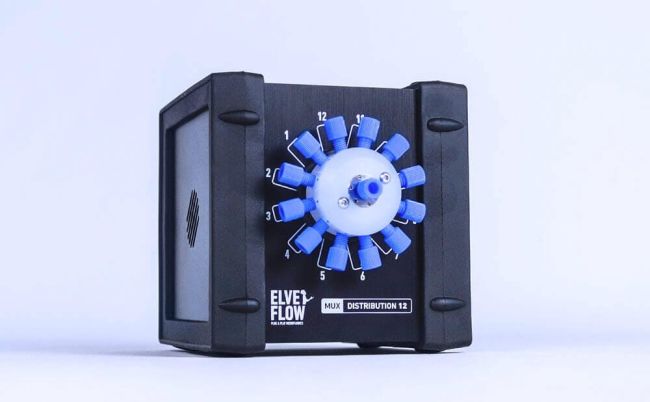
12/1 rotary bidirectional microfluidic valve to perform sequential microfluidic injections—supporting automation for up to 12 liquids.
Overview

Perform microfluidic sequential injection with the 12/1 Rotary Selector Bidirectional Valve.
Combined with the OB1 microfluidic pressure controller/regulator, the MUX Distribution valve will allow you to automate injection in microfluidic experiments, program perfusion experiments, sequentially apply different reagents and many more applications.
Benefits
Inject 1 sample into 12 outputs, or up to 12 samples into 1 output
Use the MUX Distribution valve to sequentially inject up 12 different solutions into 1 microfluidic line (or vice versa) for sample collections or parallel experiments.
- Low internal volume
- Fast switching time
- Workflow microfluidic automation
- Smooth switches: no disruption of the flow
- Easy setup and operation (plug and play software + standard fluidic connection)
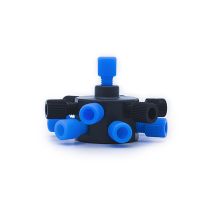
- Bidirectional 13 ports/ 12 positions sequential injection from 12 different samples into 1 output/input
Key Advantages
- Valve flexibility: 13 ports
- Easy setup: standard ¼-28 fluidic fittings
- Possibility to chose the sense of rotation
- High chemical compatibility
- Lowest internal volume: 3.5 µL
- No dead volume
- Switching time (average): 160 ms
- Wetted materials: PCTFE, PTFE
The MUX Distribution 12/1 valve can be used in various fields of application and for any experiment that requires successive injection of fluids, such as:
- Organic synthesis
- Flow chemistry
- Drug screening
- Biochemical and electrochemical sensor calibration
- Calibration (bench testing)
- Sensors test rig
- Toxicity testing
- Seq-Fish experiments
| SKU | 505987 |
|---|
-
ElveFlow OB1 Microfluidic Pressure Regulator
Request Quote - As low as $50.00
-
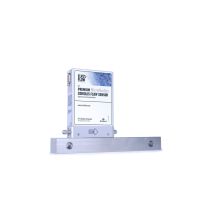
Coriolis Premium Microfluidic Flow Sensor
As low as $6,902.00


Application Notes
- How to control the flow while flow line changing with a Mux Distributor ?
- How to perform fast drug or medium switch?
- How to perform controlled drug switches with an Elveflow® MUX?
- How to perform an ultrafast microfluidic medium switch with an Elveflow® pressure & flow control instrument (OB1)
- How to perform the injection of a controlled volume of sample?
Reviews
- Microfluidics as a tool for drug delivery
- Electrochemistry and Microfluidics : A short review
- Microreactors & Microfluidics in Chemistry: a Review
- Microfluidic Nanoparticle Synthesis: A short review
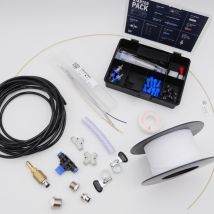
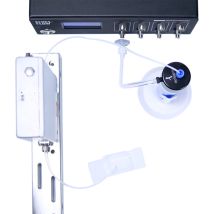
Multiple fluid switching pack - Quickly swap between fluids, gas or liquids!
How does the sequential fluid injection pack work ? - Elveflow Microfluidic Instruments
Multiple liquids switching dedicated to microfluidics
| Performances | Port to port switching time (ms) | 160 ms |
| Maximum valve update rate | 2 Hz | |
| Max recommended pressure | 7 bar | |
| Internal diameter | 0.5 mm | |
| Internal volume(1) | 3.5 µL | |
| Carryover volume(2) | 1.7 µL | |
| Dead volume (3) | None | |
| Wetted materials | PCTFE, PTFE | |
| Number or ports | 13 | |
| Number of positions | 12 | |
| Operating temperature | 5-40°C | |
| Operating Humidity | 20-70% noncondensing |
- Volume inside the system from entrance to exit
- Volume of liquid that will be mixed with the next liquid. It is not stuck, but will be swept next time a liquid passes.
- Volume that is stuck in the system (dead end), which is not clearly swept and relies on diffusion to clear out
Publications
Qian, T., Gil, D. A., Contreras Guzman, E., Gastfriend, B. D., Tweed, K. E., Palecek, S. P., & Skala, M. C. (2020). Adaptable pulsatile flow generated from stem cell-derived cardiomyocytes using quantitative imaging-based signal transduction. Lab on a chip, 20(20), 3744–3756. https://doi.org/10.1039/d0lc00546k
Mulas, C., Hodgson, A. C., Kohler, T. N., Agley, C. C., Humphreys, P., Kleine-Brüggeney, H., Hollfelder, F., Smith, A., & Chalut, K. J. (2020). Microfluidic platform for 3D cell culture with live imaging and clone retrieval. Lab on a chip, 20(14), 2580–2591. https://doi.org/10.1039/d0lc00165a
Li, J. R. Sanchez, F. Kohler, A. Røyne, & D. K. Dysthe. (2018). Microfluidic control of nucleation and growth of CaCO3. Crystal growth & design, 18(8), 4528-4535. https://doi.org/10.1021/acs.cgd.8b00508