

You've placed your trust in our TEER measurement line for nearly 40 years as the premiere innovator and manufacturer of EVOM™ meters, REMS, and Millicell ERS2. Learn more about the gold standard in EVOM™ technology that has been cited in over 10,500 published research articles.
What Is TEER?
Transepithelial/Endothelial Electrical Resistance (TEER) measurement qualitatively measures cellular monolayer health and quantitatively evaluates cellular confluence by measuring the electrical resistance across a cell monolayer. It is commonly used to assess the integrity and permeability of cellular barriers, such as epithelial and endothelial cell layers grown onto permeable membrane cell culture inserts or transwell plates. TEER can be used as the quality analysis (QA) and quality control (QC) parameter for cellular studies, such as cell therapy. TEER measurement being very simple and fast makes it a suitable screening tool for drug discovery. The use of TEER measurement to verify barrier formation and tissue function has been growing in the emerging fields of in vitro 3-D tissue models, organoids, and Organ-on-Chips. What is TEER?.
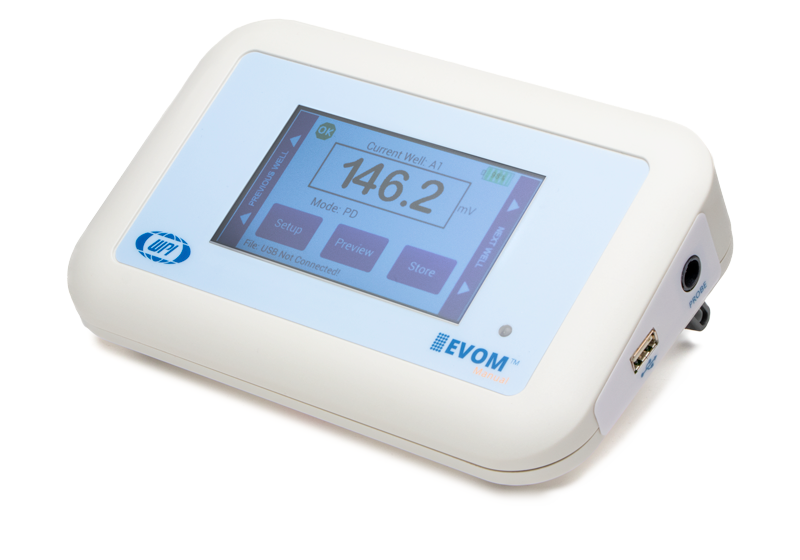
TEER is typically measured using a probe with a pair two pairs of electrodes placed on either side of the cellular monolayer, one pair in the apical compartment (above the cells) and the other pair in the basolateral compartment (below the cells). An electronic instrument such as, automated EVOM™ Auto or portable EVOM™ Manual, applies a very small magnitude (≤10 µA) fixed electrical current with switching polarity across the electrodes and measures the resulting change in the voltage. The resistance value is calculated by the instrument using Ohm's Law (R = V/I), where R is resistance, V is voltage, and I is current. TEER is the resistance multiplied by the cell growth area, and TEER values are presented with the units of ohms times square centimeters (Ω-cm²).
Since EVOM™ technology uses a small magnitude electrical current with switching polarity, TEER measurement does not cause any charging of the sample and does not have any significant physiological effect. Also, TEER measurement does not require any chemical or biological labeling. TEER can be measured in biological conductive solutions, such as cell culture media or buffer. Thus, TEER measurement by EVOM™ is a label-free and non-invasive evaluation of cellular samples. The same samples can be used for other biological studies, such as immunocytochemistry and western blots. TEER measurement studies are often complemented with additional permeability studies with tracer molecules like lucifer yellow and FITC-dextran to verify the change of epithelial and endothelial barrier function.
How EVOM™ Technology Works
Electrical resistance (i.e., TEER) of a cellular layer is the inverse presentation of the electrical conductance through the cellular layer. A high TEER value of the cellular layer is indicative of an intact cellular monolayer and suggests low or restricted permeability of ions and molecules (i.e., low conductance). Similarly, a decrease in the TEER value suggests a compromised barrier function and indicates increased permeability. Tissue permeability studies require a confluent cellular layer, and TEER measurement is generally used to confirm the formation of a confluent monolayer.
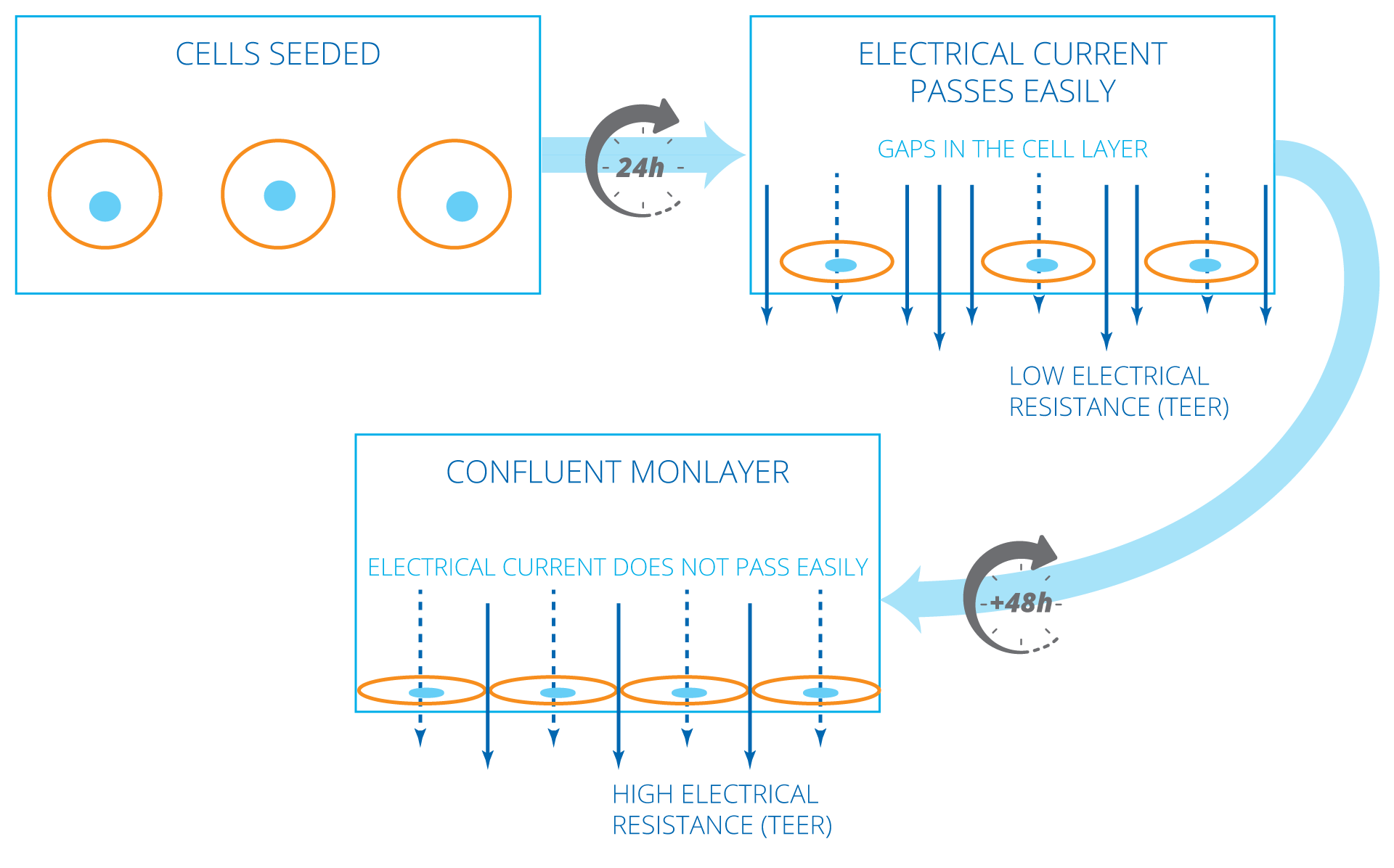
Initially, 24 hours after cell seeding transwell, TEER values are generally low, because the current passes can pass easily between the cells. Over time, the cells multiply and start covering the gaps. Finally, a confluent cellular monolayer is formed. At that point, the permeable membrane is fully covered with cells and does not allow easy passage of electrical current. This results in a high TEER value.
TEER Measurement of Leaky & Tight Cell Types
TEER values of confluent cellular monolayers can vary depending on the cell type. Monolayers of certain cell types (e.g., cell type A), which normally show low TEER values, generally have relatively leaky tight junctions. Monolayers of other cell types (e.g., cell type B) show high TEER values, and these cell types are known to have tight junctions. Ions and molecules are known to pass rather easily across leaky cellular layers as compared to tighter cellular layers. The presence of more transcellular ion channels on cells can further allow easier flow of ions or electrical current through the transcellular pathway, which can additionally lower TEER values.
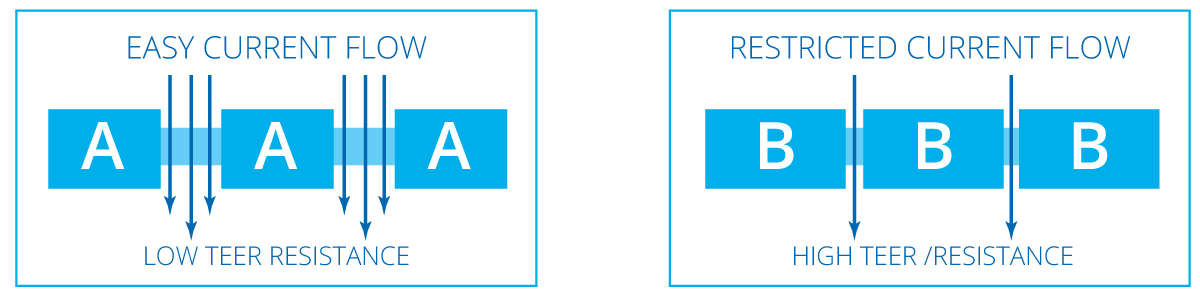
Cell type A allows greater amounts of current and ions to pass between the cells and yields a low TEER value. With its tighter junctions, cell monolayers of type B cells will show a higher TEER value. While both monolayers are confluent, the TEER resistance values can be markedly different based on the nature of the cells themselves.
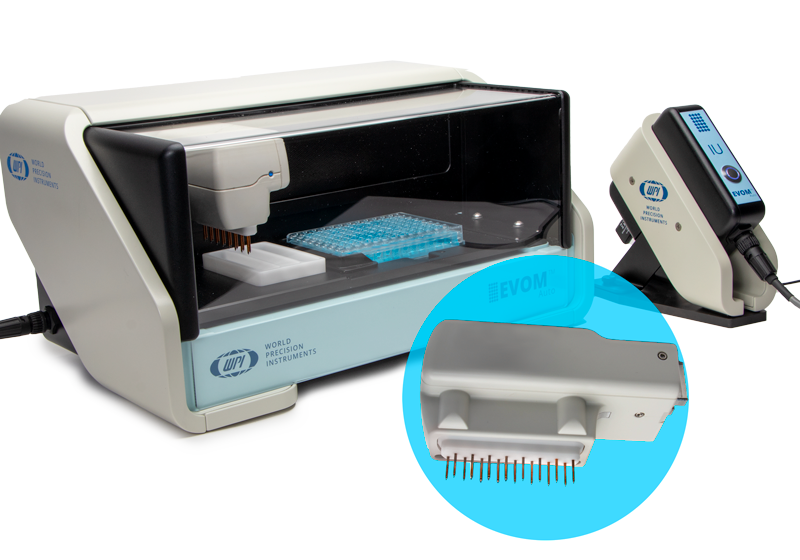
EVOM™ AUTO - 96 WELL
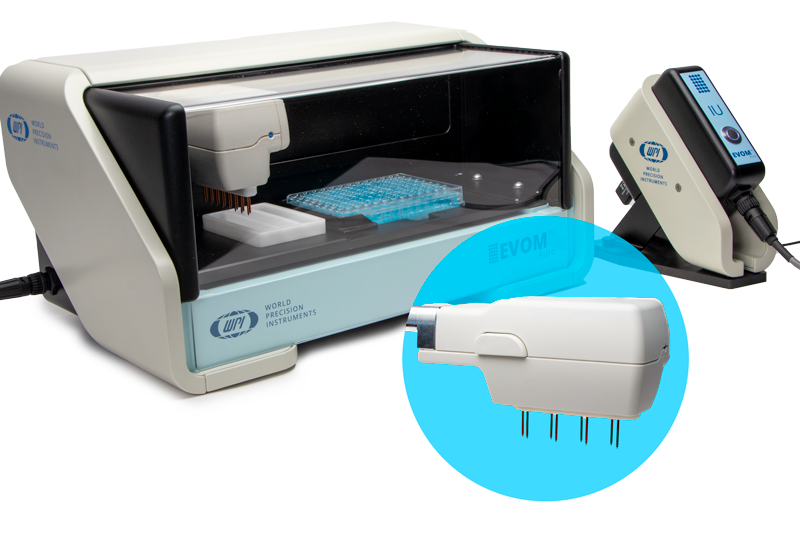
EVOM™ AUTO - 24 WELL
EVOM™ MANUAL

EVOM™ AUTO GXP
Related Applications
Assessing Epithelial Barrier Function
TEER allows researchers to evaluate the integrity and functionality of endothelial and epithelial barriers, such as the gastrointestinal, respiratory, and blood-brain barriers. By measuring the resistance across these barriers electrically, TEER provides quantitative data on the tightness and permeability of these barriers. This information is crucial for understanding drug absorption, transport mechanisms, and the effects of various compounds on barrier function.
Organoid Research
Organoids are three-dimensional, miniature models of organs and tissues that are grown in vitro from stem cells or other progenitor cells with the ability to differentiate into a cell type found in a given organ or tissue. They closely mimic the structure and function of human organs, making them valuable tools for studying human development, disease modeling, drug screening, developmental biology, precision medicine, disease mechanisms, and pathophysiology.

Drug Absorption Studies
TEER is extensively used in drug absorption studies to assess the permeability of drugs across tissue barriers. By measuring TEER before and after drug exposure, researchers can determine the impact of drugs on barrier integrity and evaluate their potential for absorption into a given tissue. This information aids in drug formulation, optimization, and predicting drug bioavailability.
Automated TEER Measurements for Rapid Screening of GI Toxicity Profiles
Tissue Engineering and Cell Culture
TEER is a valuable tool in tissue engineering and cell culture studies. It helps researchers assess the formation and functionality of epithelial cell layers, mimicking in vivo conditions. TEER measurements can guide the optimization of culture conditions, scaffold design, and cell differentiation protocols. Additionally, TEER can be used to monitor the barrier function of tissue-engineered constructs over time, providing insights into their long-term viability and functionality.
Disease Modeling
TEER is an invaluable tool for disease modeling, particularly for studying disorders affecting endothelial and epithelial barriers tissues. Researchers can use TEER to investigate the impact of diseases, pathogens, or toxins on barrier integrity and function. This enables a better understanding of disease mechanisms, identification of potential therapeutic targets, and evaluation of drug efficacy in disease models.
Quality Control in Cell-Based Assays and Cell Therapies
TEER serves as a quality control measure in cell-based assays involving endothelial and epithelial cells. It ensures the consistency and reliability of experimental results by confirming the formation of tight junctions and functional epithelial barriers. TEER measurements can help identify potential issues with cell culture conditions, cell quality, or experimental protocols, ensuring the validity of research findings. Furthermore, TEER is now being implemented as a quantitative quality control measure for certain cell therapies.

Manufacturing QC
TEER measurements are often utilized to establish the baseline parameters of an OoC system prior to an experiment. By regularly monitoring TEER values at various stages of production, manufacturers can assess the consistency and reproducibility of the cell barrier properties across multiple OoC devices. TEER can measure the porosity of a membrane within an OoC setup and can also establish when seeded cells have formed a mature barrier and are ready for testing. As OoC applications are scaled up and standardized, the importance of implementing QC into the manufacturing process becomes even more critical and TEER is a facile and cost-effective way to assure the OoC systems are manufactured correctly and meet specifications.


EVOM2 Cell Culture Cup Chambers for TEER Measurement
These Cell Culture Cup Chambers used in TEER measurement for removable culture cup systems using EVOM2 meters for endothelial and epithelial cell cultures.

STX HTS EVOM™ Electrode
Semi-permeable HTS (high throughput screening) culture plates have become a standard tool for pharmaceutical and institutional research in epithelial transport.

Sterile Disposable Rinse Station Inserts of EVOM™ Auto
These disposable rinse stations fit conveniently inside the rinse station of the EVOM™ Auto Automated TEER Measurement system for effective and convenient electrode cleaning, disinfection, and maintenance.