Page 3 - Surgical Instruments
- - August 22, 2023
Surgical forceps have been used in various forms from ancient times and have evolved into a indispensable instrument for modern surgeries. Forceps are surgical instruments for the practice of medicine which are used for grasping, holding, and manipulating tissues and objects during surgical procedures.
- - August 10, 2023
Building a custom surgical instrument kit gives you the flexibility, precision, and control you need to advance medical knowledge, improve patient outcomes, and push the boundaries of surgical science.
- - July 14, 2023
When it comes to sterilizing lab forceps, it is crucial to follow proper protocols to maintain a sterile environment and prevent cross-contamination. Like other surgical instruments, laboratory forceps may be sterilized by autoclaving, dry heat, or a chemical sterilant. However, forceps are uniquely designed for many specific functions, and a few pointers here can ensure you get the best results.
NOTE: Always follow the manufacturer's instructions and best practices to ensure effective sterilization and maintenance of your lab forceps.
- - July 05, 2023
In any laboratory, having key lab supplies is almost as important as having the major equipment. Choosing a reputable supplier of these necessary supplies is as important as having quality laboratory supplies when you need them. WPI wants to be your partner in early drug discovery, and we stock a wide variety of lab supplies, many of which can ship the same business day. Having a variety of lab supplies ready to ship makes us a dependable research partner. Here are some of the popular supplies that we keep on hand to meet your needs for your upcoming experiment
- - June 22, 2023
Hemostatic forceps, hemostats, are used primarily to control bleeding during surgical procedures, and they are also used for a variety of other applications. Most hemostatic forceps have ring handles and a ratchet-style, locking mechanism to adjust the tension on the forceps and to keep the jaws clamped in place, maintaining constant pressure on the tissue or blood vessel being occluded. They also have jaws with interlocking serrations or teeth for a secure grip on tissues. The tips of hemostats are often narrow and delicate, allowing for precise manipulation of tissues and vessels. They vary in size, tip shape, type of metal, and function. Here are some applications for which hemostatic forceps are uniquely designed.
- - June 09, 2023
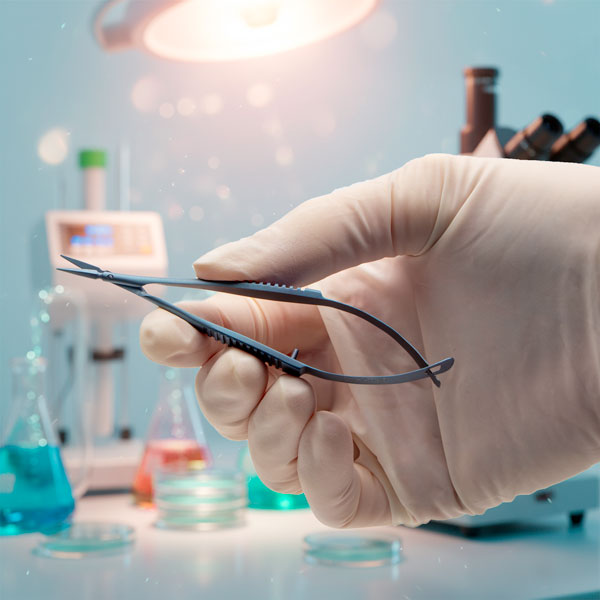
One of the most common surgical instruments in a laboratory is lab forceps or tweezers. Thumb forceps used in a lab come in various lengths, and the tips can be straight, curved, angled, or angled on the side. They can be made of stainless steel, German steel, Dumoxel, Dumastar, or titanium. They can have smooth tips, serrated tips, or teeth. They are even available with tungsten carbide inserts. Each style has its own purpose.
In general, however, lab forceps are used to handle and transfer small objects, such as samples, solid materials, or delicate components. The fine tips of forceps allow for precise manipulation and control. For now, here's a quick rundown of some of the popular applications for lab forceps in various types of labs.
- - June 06, 2023
This article shows you how to appropriately care for your surgical insturments to ensure long lasting, highly functioning tools for your application.
- - May 31, 2023
In a life science laboratory, quality surgical scissors are indispensable for dissection, suturing, small animal surgeries, tissue preparation, and more. The variety of surgical scissors can be overwhelming. To help you choose which surgical scissors are right for your application, let’s look at some of our most popular ring handled surgical scissors and their intended uses.
- - May 16, 2023
Surgical forceps or surgical tweezers are common surgical instruments, but there's a large variety of tweezers to choose from. In general forceps can be grouped as thumb forceps (frequently called surgical tweezers, gripping forceps, non-locking forceps or pinning forceps) or ring forceps (also called hemostats, hemostatic forceps and locking forceps). Thumb forceps are spring forceps used by compression between your thumb and forefinger and are used for grasping, holding or manipulating tissue or objects. They are non-ratchet style. Hemostatic forceps are hinged forceps that look more like scissors with ring handles. Focusing on thumb forceps, they can be further categorized as tissue forceps and dressing forceps. Let's explore the differences between tissue forceps and dressing forceps for surgical applications and research laboratories.
Tissue Forceps
Tissue forceps are used to hold and manipulate delicate tissues during surgical procedures or laboratory work. They have a fine tip...more
- - June 05, 2022
WPI offers a variety of scissors which are widely used in healthcare units, hospitals and laboratories. Most scissors have ring handles.
Let's take a look at the the anatomy of a standard pair of scissors.
Cutting edge lengths are measured as the operational length of the cutting edge, the operational blade length. The cutting edge length on standard scissors is a little subjective, depending on the hand size of the operator. Open the scissors to a normal, natural position, and measure the distance from the tip to where the two blades cross. This is the maximum the jaws will open without unnatural manipulation. The blade length is a little longer and is measured from the hinge to the tip of the blade. The blade length corresponds with the depth of the incision you wish to make. The smaller sized blades are used at the surface for small incisions, and the longer blades go deeper into cavities.
The hinge is the point where the two blades connect. It may have a tension screw, which...more
- - May 04, 2022
Sapphire Blades are a precise and durable solution for use in microsurgery, dissection, and related applications.
How are Sapphire Blades Manufactured?
Sapphire blades are created using a chemical process which forms an artificial sapphire. The sapphire has a hardness value of 9 on the Mohs hardness scale, slightly below the hardest mineral on earth- the diamond. This characteristic provides supreme durability and sharpness to the blade.
Why Choose a Sapphire Blade?
...moreUltra Sharp
The sapphire blade's ultra sharp edge creates fine and precise cuts that prevent tissue damage and promote faster healing with less scarring.
Easier Use
The sapphire knife's ergonomic grip offers an easier grasp and is designed to be used with WPI's blades.
Longer Lasting
The blade's chemical composition provides a durable edge that lasts longer than steel surgical instruments, saving costs for your practice.
Greater Precision
The blade's sharp point and transparent finish allows greater precision in hair restoration,
- - April 19, 2022
Needle holders, also known as a needle drivers. They are used in wound closure, ligation, reanastomosis and other surgical procedures which require suturing. The needle is usually held in position by a clamp mechanism, which allows the operator to manipulate the needle through various tissues. The jaws are generally textured and short in comparison to the shank to retain a solid grasp on the needle.
- - March 14, 2022
In this video, you get some practical tips on sterilizing your surgical instruments and using an autoclave. This video is the fourth in a series of four to discuss some best practices in caring for your surgical instrument investment.
Autoclaving, which is saturated steam under high pressure, is the most common method for sterilizing surgical instruments, but a cold sterilization method may also be used.
Prior to sterilization, clean the instruments and lubricate all hinged instruments with a surgical instrument lubricant. *Do not use WD-40, oil or other industrial lubricants.*
Cold Sterilization
Cold sterilization involves soaking instruments in a cold sterilant like Cidex® for at least 10 hours. This process may be detrimental to fine instruments.
If disinfection is all that is required (and not sterilization) a 10–90 minute soak in Cidex® may be all that is necessary.
When using instruments with tungsten carbide inserts, avoid using solutions with benzyl ammonium chloride
...more
- - March 09, 2022
In this video, you can see how to mechanically clean surgical instruments using an ultrasonic cleaner. This video is loaded with tips. This video is the third in a series of four to discuss some best practices in caring for your surgical instrument investment.
Ultrasonic is the most effective cleaning method, because of its cavitation. Vibrating sound waves create micron-size bubbles in solution that grow as the pressure in the unit changes. Eventually the bubbles implode. The bursting bubbles effectively dislodge debris, even in the most difficult to reach places. Use of ultrasonic detergent greatly improves the effectiveness of the cleaner, because it increases the number of tiny bubbles.
Rinsing Instruments
Immediately after use, rinse instruments under warm or cool running water to remove all blood, body fluids and tissue. Dried soils may damage the instrument surface and make cleaning difficult. Do not use hot water since this causes proteinous substances to coagulate.
Process...more
- - March 07, 2022
In this video, you can see how to manually clean surgical instruments. It is loaded with tips. This video is the second in a series of four to discuss some best practices in caring for your surgical instrument investment.
If instruments are easily damaged, complex and requiring disassembly, or have small lumens, they may need to be cleaned manually.
Personal Protective Equipment
When cleaning your instruments manually, wear heavy-duty rubber gloves, a plastic apron, eye protection and a mask.
Cleaning Materials
Remember, use stiff plastic cleaning brushes. Do not use steel wool or wire brushes.
Use only neutral pH detergents. If the instruments are not rinsed properly, low pH detergents may breakdown the stainless protective surface and cause black staining.
High pH detergents may cause surface deposits of brown stains, which can interfere with the smooth operation of the instrument.
Process
- Brush delicate instruments carefully and handle them separately from general instruments...more

Recent Posts