FAQ
- - January 17, 2025
One of our frequently asked questions (FAQs) concerns TEER measurements with an EndOhm. If the resistance readings from your ENDOHM don't stabilize, you may need to do some troubleshooting.
- - November 02, 2023
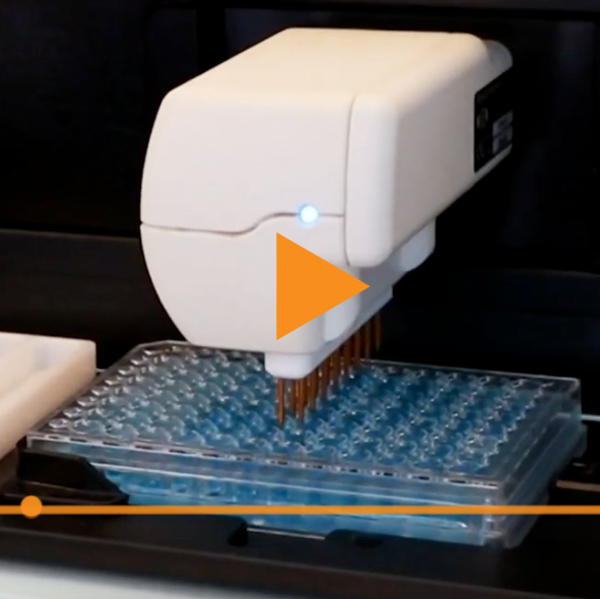
EVOM™ Auto is WPI’s latest high throughput screening TEER measurement system with 24 and 96 HTS transwell plate measurement capability, and it offers easy options for switching between different plates. I will show you how to setup it up. The Interface Unit is the controller that establishes communication between the EVOM™ Auto software and the autosampler.
- - October 31, 2023
EVOM™ Auto High Throughput (HTS) Transepithiel Electrical Resistance (TEER) Measurement System with 24 and 96 transwell capability can switch between different 24 and 96 HTS transwell plates by using matching electrode arrays and plate positioner. Here we demonstrate how to install a well plate.
- - October 26, 2023
The EVOM™ Auto High Throughput (HTS) Transepithiel Electrical Resistance (TEER) Measurement System with 24 and 96 transwell capability has a removable electrode array head. Different electrode arrays can be used with the same system to analyze a variety of 24 and 96 transwell HTS plates.
- - October 24, 2023
EVOM™ Auto High Throughput (HTS) Transepithiel Electrical Resistance (TEER) Measurement System with 24 and 96 transwell capability can switch between different 24 and 96 HTS well plates by using matching electrode arrays and plate positioners. Here we demonstrate how to switch to a 24 transwell plate after using a 96 transwell plate.
- - April 07, 2021
Vernier scales can be used on microscopes, stereotaxic frames and micromanipulators. The vernier scale was invented by French mathematician Pierre Vernier in 1631 as an upgrade on Pedro Nunes' measurement system for precision astrolobes. With a main scale and a sliding secondary scale, a vernier is used for making precise measurements.
How a Vernier Scale Works
The vernier scale is marked with divisions slightly smaller than the divisions of the main scale. For example, a vernier scale could have 11 markings for every 10 on the main scale. That's 10 divisions on the vernier scale for every 9 on the main scale. This means that the vernier divisions are each 90% of the main scale divisions. In this case, the 0-line and the 10-line on the vernier could pair up with marks on the main scale, but none of the other divisions on the vernier would match a line of the main scale. For example, the 0 and 10-lines of the vernier scale could pair up with the 0 and 9-lines on the main scale...more
- - April 29, 2019
Here are some frequently asked questions (FAQ) about Metal Microelectrodes.
...moreWhat metal type is best for my application?
W- Tungsten
Tungsten is a versatile and widely-used microelectrode material that offers a good balance between performance and cost.
ADVANTAGES
DISADVANTAGES
- Extremely strong and stiff metal provides probes with exceptional rigidity.
- Great for acute and chronic recording due to biocompatibility and lower cost.
- High corrosion resistance offers consistent long-term performance.
- Does not provide the same degree of electrochemical performance or stability as platinum-iridium alloy, making it a poor alternative for microstimulation.
- Lower charge transfer capacity of tungsten will result in larger, potentially unsafe interfacial potentials when applying the same stimulation current as to a platinum-iridium electrode.
- Certain pH or stimulation conditions can lead to tungsten corrosion.
PI- Platinum-Iridium Alloy
Platinum-Iridium alloy is considered by many to be the “gold standard”
- - February 01, 2015
Here are some frequently asked questions (FAQ) about TEER measurement using an EVOM2.
- - April 25, 2013
A 4-way stopcock allows for 360 degrees of rotation and has the states (shown below) for each of the four available positions. A 3-way stopcock has only three positions and has the first three states shown below. In the first state, liquid flows between points A and B.
In the second, it flows between points A and C.
In the third, it flows between points B and C.
In the fourth state (4-way only), it flows between all three points.While they are sold in the popular kit 14011, they are also sold separately:
- 14035-10–4-way Stopcock, Luer Lock (pkg. of 10)
- 14036-15–4-way Luer Stopcock (pkg. of 15)
- 14057-10–4-way Stockcok, Luer Lock, Blue (pkg. of 10)
Recent Posts