Page 21 - Blog
- - April 24, 2022
ATC2000 is a low noise heating system for maintaining animal body temperature during experimental procedures. The ATC2000 has three temperature sensors. One is located in the heated plate, and the other two can be plugged into the RTD and TC input ports. The ATC2000monitors all three temperature readings. You can choose which of the three the unit will control. The ATC2000 then heats (or stops heating) the plate to keep the controlled temperature within the alarm limits.
- To set the controlled temperature, press the SRC button.
- Press the Up or Down key to select a temperature source.
NOTE: If the unit is placed in adaptive mode, then the heater plate is not available as a temperature source option here. - To make the selected temperature source the default temperature source, press the SRC button again. A *D* appears on the display next to your choice to indicate that it is the default temperature source. The unit will retain the default setting even after you power off the ATC2000...more
- To set the controlled temperature, press the SRC button.
- - April 21, 2022
ATC2000 is a low noise heating system for maintaining animal body temperature during experimental procedures. The temperature controller provides electrically quiet control over the heating plate, so that you can place the animal directly onto the heating plate. Here’s how to set up the system.
- Connect the heating plate to the Plate connector. Line up the pins, press it into place and screw it in place finger tight.
- Connect the rectal temperature probe to one of the Inputs on the ATC 2000. If it is an RTD temperature sensor, plug it into the RTD port. If it is a thermocouple sensor, plug it into the TC port.
- Assemble the power supply and the cord, and plug the power supply into the back of the ATC2000.
- Turn on the ATC2000 using the power switch on the back of the unit.
- Adjust the set point, if necessary.
- The unit always powers up in Normal mode with the heat source set as default heat source from the previous use. Typically, the plate temperature is the control value used until it...more
- - April 19, 2022
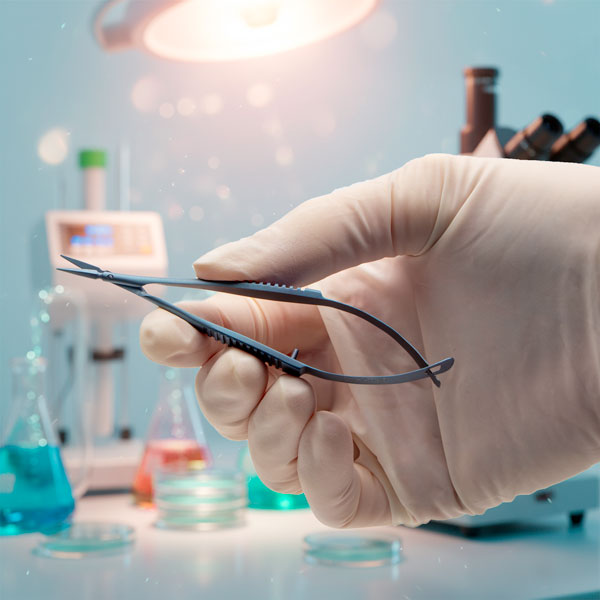
Needle holders, also known as a needle drivers. They are used in wound closure, ligation, reanastomosis and other surgical procedures which require suturing. The needle is usually held in position by a clamp mechanism, which allows the operator to manipulate the needle through various tissues. The jaws are generally textured and short in comparison to the shank to retain a solid grasp on the needle.
- - April 19, 2022
ATC2000 is a low noise heating system for maintaining animal body temperature during experimental procedures. Here we will look at the main display on the front panel to see what information is available and the three operational modes.
The main display window shows the set point and the mode of operation on the left side of the screen. On the right side, the control temperature and plate temperature are visible. The arrow next to the TC Probe indicates that the TC Probe is the controlled temperature.
TEMPERATURE DISPLAY
In this illustration, the unit is controlling the thermocouple (TC) probe. In this case, the RTD probe temperature can be viewed by pressing the Display button. When the unit controls the RTD probe, that temperature displays on this screen. The OK next to a temperature indicates that the temperature falls within the parameters defined by the low and high alarm limits. If the temperature falls below the low limit, LO displays instead of OK. Likewise, if it exceeds the high...more
- - April 17, 2022
The ATC 2000 is a low noise heating system for maintaining animal body temperature during experimental procedures. Here are five reasons to choose the WPI Animal Temperature Controller. WPI's Adaptive control is unique in the industry, giving you precision control without the need for complex programming when it counts. Simple to setup. Stable control. No local hotspots.
1. ELECTRICALLY QUIET:
The DC heater is extremely quiet in terms of electromagnetic radiation. This is essential in electrophysiological recordings which are very sensitive to electromagnetic interference.
2. PRECISE & STABLE CONTROL:The controller uses proportional, integral, and differential (PID) technology in adjusting the DC voltage output. Compared with switched on/off type controllers, PID controllers provide a much more precise and stable control of temperature. The PID approach is also more immune to the variation of the experimental conditions such as change in animal size and unexpected disturbances...more
- - March 14, 2022
In this video, you get some practical tips on sterilizing your surgical instruments and using an autoclave. This video is the fourth in a series of four to discuss some best practices in caring for your surgical instrument investment.
Autoclaving, which is saturated steam under high pressure, is the most common method for sterilizing surgical instruments, but a cold sterilization method may also be used.
Prior to sterilization, clean the instruments and lubricate all hinged instruments with a surgical instrument lubricant. *Do not use WD-40, oil or other industrial lubricants.*
Cold Sterilization
Cold sterilization involves soaking instruments in a cold sterilant like Cidex® for at least 10 hours. This process may be detrimental to fine instruments.
If disinfection is all that is required (and not sterilization) a 10–90 minute soak in Cidex® may be all that is necessary.
When using instruments with tungsten carbide inserts, avoid using solutions with benzyl ammonium chloride
...more
- - March 09, 2022
In this video, you can see how to mechanically clean surgical instruments using an ultrasonic cleaner. This video is loaded with tips. This video is the third in a series of four to discuss some best practices in caring for your surgical instrument investment.
Ultrasonic is the most effective cleaning method, because of its cavitation. Vibrating sound waves create micron-size bubbles in solution that grow as the pressure in the unit changes. Eventually the bubbles implode. The bursting bubbles effectively dislodge debris, even in the most difficult to reach places. Use of ultrasonic detergent greatly improves the effectiveness of the cleaner, because it increases the number of tiny bubbles.
Rinsing Instruments
Immediately after use, rinse instruments under warm or cool running water to remove all blood, body fluids and tissue. Dried soils may damage the instrument surface and make cleaning difficult. Do not use hot water since this causes proteinous substances to coagulate.
Process...more
- - March 07, 2022
In this video, you can see how to manually clean surgical instruments. It is loaded with tips. This video is the second in a series of four to discuss some best practices in caring for your surgical instrument investment.
If instruments are easily damaged, complex and requiring disassembly, or have small lumens, they may need to be cleaned manually.
Personal Protective Equipment
When cleaning your instruments manually, wear heavy-duty rubber gloves, a plastic apron, eye protection and a mask.
Cleaning Materials
Remember, use stiff plastic cleaning brushes. Do not use steel wool or wire brushes.
Use only neutral pH detergents. If the instruments are not rinsed properly, low pH detergents may breakdown the stainless protective surface and cause black staining.
High pH detergents may cause surface deposits of brown stains, which can interfere with the smooth operation of the instrument.
Process
- Brush delicate instruments carefully and handle them separately from general instruments...more
- - March 03, 2022
What's the difference between cleaning, disinfecting and sterilizing? Let's take a look. This is the first in a series of four videos to discuss some best practices in caring for your surgical instrument investment.
Surgical instruments are crucial in your research, and proper cleaning, handling and storage will ensure your instruments last for many years to come.
First of all, before we begin, let me remind you not to use alcohol for cleaning. It is not a good cleaning agent, and because of its rapid evaporation, it cannot sterilize instruments. Now, in this series of videos, we will talk about the three levels of surgical instrument care -- cleaning, disinfecting and sterilizing.
Cleaning
Cleaning removes dirt, debris and biological material from surgical instruments. To maximize the useable life of your instruments, never allow blood to dry on surgical instruments. Within 10-20 minutes after a procedure, open all the instruments and begin a decontamination process.
To prevent blood...more - - February 22, 2022
Adjustable Height/Working Distance
WPI's 3D SpectaSCOPE™ Inspection Scope is a true 3D digital stereo optical scope with a host of innovative patent-pending features.
It all starts with the fully optical zoom system, which is sending the smallest details to its two powerful HD 5MP cameras. The images are then transmitted at full speed frame rates to the on-board HD screens, giving you a true three-dimensional image. You choose the most comfortable position for the viewer’s tilting headset.
The 3D SpectaSCOPE™ is easy to set up. Here we show you how to adjust the height and working distance of the 3D SpectaSCOPE™.
Step 1. Use the adjustment knob to move the manual focus to the middle of the range.
Step 2. While supporting the arm, loosen the tension adjustment knob/handle to move the head up or down.
Step 3. Using a ruler, adjust the scope head so it is 200mm from the top of the subject you wish to view.
Step 4. Tighten the tension adjustment knob/handle.
Step 5. Looking...more

Recent Posts