Page 37 - Blog
- - April 28, 2013
Download a PDF version of the Biosensor Specifications Sheet here.
WPI offers a range of biosensors for monitoring nitric oxide, hydrogen peroxide, oxygen and hydrogen sulfide. Specifications for these sensors are detailed below.
- The macrosensors are 2mm "wet" sensors. These sensors are installed in a metal "sleeve" that looks like a tiny soda straw.The sleeve has a gas permeable membrane at the tip, and it is filled with an electrolyte. When it is immersed in a solution, the gas in solution (for example, nitric oxide) diffuses through the membrane, and the sensor measures it.
- The microsensors are "dry" sensors. Most microsensors monitor nitric oxide, and there is also a hydrogen peroxide microsensor available.
Macrosensors (2mm)
WPI's 2mm macrosensors are uniquely designed with an internal reference electrode. These sensors are designed for use with the TBR1025, or TBR4100. The ISO-OXY-2 and the OXELP sensors have the same specifications. However, they have different connectors...more
- - April 28, 2013
When it comes to setting up microinjection systems, the options appear endless. The pictures below give some broad suggestions on how you might set up your own system. Keep in mind that many parts are interchangeable depending on your needs or preferences.
In general, you will need a stereo microscope on a stand, a light source, one or two micromanipulators with stands, and one or two injection systems. The following images show various setups for microinjection, and all the WPI part numbers are included for easy reference.
Remember, when you set up your own system, choose the parts that fit your needs. For example:
- M10 or the M9 magnetic base could be used.
- PZMIV stereo microscope could be used instead of the PZMIII stereomicroscope.
- M3301 or the KITE micromanipulators can be used, and these micromanipulators can be placed on either side. (Keep in mind, though, if you wanted to use a KITE micromanipulator on the right side of the setup below, you would order a KITE-R (right hand), or...more
- - April 28, 2013
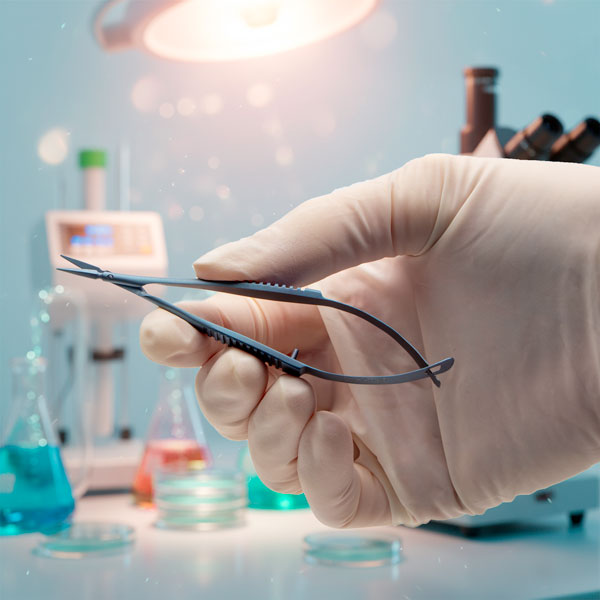
When applied to surgical instruments, Diamond-Like Carbon coating dramatically increases the life of the instrument. Because DLC-coated surgical instruments are incredibly durable and resistant to wear from chemicals, moisture and atmospheric conditions, they have a much greater useful lifespan. According to the manufacturer, pure DLC coatings as thin a 2-3μm can increase the lifespan of a pair of Vannas scissors more than 100 times that of its uncoated counterpart.DLC is a revolutionary new coating that is being tested in a variety of industries. For example, when engine parts are coated, the DLC reduces friction and corrosion, increasing the life of the engine. In a completely different industry, DLC coating is being tested on metal heart valves. The coating is non-toxic, and it is so slick that biological material isn't likely to stick to it. Additionally, heart valves coated with pure DLC will last longer than their recipients, more than a hundred years.
What is it?
Natural diamonds...more
- - April 28, 2013
These instructions describe how to properly focus a binocular microscope.
- Turn on the lamp and adjust its intensity.
- Adjust the interpupilary distance so that the two circles of light merge into one.
- Place a sample on the stage.
- Select the 10X objective and look through the right eyepiece only.
- Use the coarse and fine focus control knobs to adjust the focus of the sample.
- When the sample is clearly visible, use only your left eye. Do NOT adjust the focus knobs. Instead, adjust the diopter on the left eyepiece until the sample comes clearly into view. The image should be clear with both eyes open.
- Choose the desired objective. You may need to adjust the fine focus a little.
- - April 28, 2013
NOTE: For an introduction to microscopes, see Microscope Basics.
A variety of microscope objectives are available. All objectives use lenses to focus light. Light is broken down into various wavelengths (colors) as it travels through a lens. The various wavelengths have different focal points. That means that red, green and blue appears to focus at different points. This is called chromatic aberration. Spherical aberrations are focal mismatches caused by the shape of the lens. Quality lenses are designed correct for chromatic and spherical aberration to bring the primary colors to a common focal point. These terms may help you determine the best objective for your application:
Achromatic objectives–This objective brings red and blue light to a common focus, and is corrected for spherical aberrations for green. It is excellent for black and white viewing. If an objective is not labeled, it is achromatic.
Fluorite or semi-apochromat objectives–These lenses are chromatically corrected...more
- - April 28, 2013
Microscopes are a standard laboratory tool, but purchasing the right microscope for a particular application can be a challenge. First, consider how you will use the instrument. Are you looking at slides, dissecting a small animal or performing a surgery? (The application dictates the necessary working distance and power of magnification.) What kind of a stand will you be using? (Boom stand, articulating arm or post stand) Will the microscope be used in a classroom setting? (A trinocular scope offers the option of including a camera.) Will you need a camera? (A camera allows you to project the microscope image on a PC or TV or to take still images.) The answers to these questions help you determine the required working distance, level of magnification, type of mounting stand and hardware required.
Parts of a Microscope
Eyepiece–Two or more lenses are contained in the eyepiece, and a variety of eyepieces can be used in a microscope. Typical eyepiece magnification ranges are 10X, 15X...more - - April 28, 2013
-
- - April 25, 2013
Isolated Stimulation and Stimulus Isolators
The term stimulation refers to the delivery of energy of some kind to a biological tissue in order to elicit an observable response.
Although the energy used in stimulation may be chemical, thermal, mechanical or electrical, this discussion will focus on electrical stimulation. Electrical stimulation of biological tissues involves the delivery of current and voltage to the stimulation site. The two quantities are related by Ohm's law:
V=IR
Where V is the applied voltage, I is the current and R is the electrical resistance of the tissue and or the stimulating electrodes. This simple equation shows that if voltage is constant, current flow will diminish if the tissue/electrode resistance goes up, and will increase if the resistance decreases.
More commonly, the resistance of tissue differs from sample to sample, and the resistance of the electrodes changes with applied current over time in a process called polarization.
Types of Stimulus Devices...more
- - April 25, 2013
A 4-way stopcock allows for 360 degrees of rotation and has the states (shown below) for each of the four available positions. A 3-way stopcock has only three positions and has the first three states shown below. In the first state, liquid flows between points A and B.
In the second, it flows between points A and C.
In the third, it flows between points B and C.
In the fourth state (4-way only), it flows between all three points.While they are sold in the popular kit 14011, they are also sold separately:
- 14035-10–4-way Stopcock, Luer Lock (pkg. of 10)
- 14036-15–4-way Luer Stopcock (pkg. of 15)
- 14057-10–4-way Stockcok, Luer Lock, Blue (pkg. of 10)

Recent Posts