Page 9 - Product Information
- - June 15, 2022
WPI carries a wide variety of fluid handling tools utilizing different technologies: - Microinjectors
- Peristaltic pumps
- Syringe pumps
- Pneumatic injectors
The range of applications and the criteria used to select a particular pump or injector is broad and complex, and we encourage you to call us at (866) 606-1974 or email customerservice@wpiinc.com and speak with an application specialist. In the meantime, here is a listing of our popular pumps and injectors sorted by technology, flow range and special features.
Special features tell you about applications or functionsof the pump. Many of the syringe pumps can be had with an alarm option that alerts you to the end of travel or blocked flow. The onew with the “P” option allow for programmable flow and volume profiles without using the RS232 computer interface.
Frequently used terms:
- Infuse/Withdraw (I/W): Describes a feature of a syringe pump whereby the syringe plunger is held by the pusher so the motor can pull the plunger back, withdrawing...more
- - May 30, 2022
WPI’s EVOM™ Manual is the gold standard for delivering stable and repeatable Trans Epithelial Electrical Resistance (TEER) measurements. The EVOM™ Manual qualitatively measures cell monolayer health and quantitatively measures cell confluence by determining an increase or a plateau in tissue resistance detected using our innovative EVOM™ technology. The main display window has lots of information. Here’s a quick overview. You can download the infographic for a handy reference.
- - May 23, 2022
WPI’s EVOM™ Manual is the gold standard for delivering stable and repeatable Trans Epithelial Electrical Resistance (TEER) measurements. The EVOM™ Manual is the newest TEER meter. It qualitatively measures cell monolayer health and quantitatively measures cell confluence by determining an increase or a plateau in tissue resistance detected using our innovative EVOM™ technology. WPI’s state of the art EVOM™ technology provides you with real-time, valuable feedback during experimental measurements.
- - May 19, 2022
The new STX4 electrode works with the EVOM3, and the blades are replaceable. EVOM3 is used for making TEER (TER) Measurements in cell culture plates. Here's a quick tutorial to show you how to replace the blades.
- - May 05, 2022
The ATC2000 is a low noise heating system for maintaining animal body temperature during experimental procedures. It has three modes of operation, which we discuss here.
Normal mode compares the temperature and the setpoint for PID control. Adaptive mode is ingenious. It uses the monitored animal temperature and the actual plate temperature to define an offset value which is used to adjust the PID parameters. That offset is recalculated at a set interval for extremely precise control. Shutdown mode is a fail safe that shuts the unit down if the plate temperature reaches a defined setpoint (like 45ºC) that would endanger the animal.
The instrument has three modes of operation:
- Normal
- Adaptive
- Shutdown
Normal Mode
The normal mode compares the temperature of the configured sensor (RTD or TC) with the set point to control the heater.
Adaptive Mode
In the adaptive mode, the sensor in the heated plate is used as the control trigger for the set point. A platinum sensor in the plate monitors...more
- - May 03, 2022
The ATC2000 is a low noise heating system for maintaining animal body temperature during experimental procedures. Here we show you how to reset the factory defaults on your ATC2000.
To reset all the configuration parameters to the factory defaults:
- Turn the unit off.
- Then, hold down both the Up and Down buttons while you turn the unit on again.
All customized paramaters will be set to the original factory default settings.
If you have any questions, just give us a call.
- - May 01, 2022
The ATC2000 is a low noise heating system for maintaining animal body temperature during expiremental procedures.
Here are some common issues you may encounter:
- No power. If you have no power, you may have a poor connection. Check the power cable connection.
- ERROR displays instead of a temperature. If ERROR displays instead of a temperature on the main display, you may have a poor probe connection. Disconnect the probe and properly re-connect it to the ATC2000.
- Animal cannot reach set temperature. If the animal cannot reach the set temperature, you may have insufficient heating power. The maximum power output on the heating device is 30W. In most situations the power is sufficient to keep the animal warm up to 40˚ C. To minimize heating loss, insulate the bottom of heating plate and cover the animal with a small blanket to keep it warm.
- Alarm is sounding. If an alarm is sounding, you may have poor transfer of heat from the heating plate to the animal. (The plate is hot, but the animal...more
- - April 28, 2022
The ATC-2000 is a low noise heating system for maintaining animal body temperature during experimental procedures. The ATC-2000 uses a digital PID controller to regulate the application of power to the heating plate to achieve the desired temperature at the monitored sensor. PID stands for Proportional, Integral and Differential. If the factory default PID settings do not adequately stabilize the system, you can manually adjust the PID parameters. WPI doesn't reccomend changing these parameters manually unless you are familiar with the functions of each PID parameter.
Setting PID Parameters
- Press the PID button to display the PID screen. The two arrows on the screen indicate which digit is being adjusted.
2. Press the Config button to select the P line to modify the proportional value, I line to modify the integral value or the D line to modify the differential value.
3. Press the PID button to select the digit to modify. Each time you press the PID button, the top arrow moves...more - - April 27, 2022
The ATC2000 is a low noise heating system for maintaining animal body temperature during experimental procedures. The ATC2000 uses a digital PID controller to regulate the application of power to the heating plate to achieve the desired temperature at the monitored sensor. PID stands for Proportional, Integral and Differential. Here’s how PID control works:
The default set point is 37°C, but you can configure it. The controller calculates the error, which is the difference between the present temperature and the desired temperature.
Error = Monitored temperature – Set point
Three individual components are derived by applying different functions to the error.
The default set point is 37°C, but you can configure it. The controller calculates the error, which is the difference between the present temperature and the desired temperature.
Error = Monitored temperature – Set point
Three individual components are derived by applying different functions to the
- The error is multiplied by the proportional...more
- - April 26, 2022
ATC2000 is a low noise heating system for maintaining animal body temperature during experimental procedures. Here we will look at how to adjust the basic configuration parameters. From the configuration menu, you can:
- Adjust the set point temperature
- Set the high and low alarm limits
- Enable/disable the audible alarm
- Adjust the three temperature offsets
- Enable adaptive mode and setup the adaptive interval
- Change the shutdown temperature setpoint
You can use the same procedure to adjust any ATC2000 configuration parameter, regardless of which parameter you’re adjusting.
- Press the Config button to access the Configuration menu. Press the Config button again to toggle to the parameter you want to adjust.
- Then use the Up or Down button to make an adjustment.
- Press the Display button to save the parameter.
Temperature Setpoint
You may adjuSetting Low Alarm Limit
Likewise, you may set the Low Alarm Limit. If the controlled temperature falls below the low alarm temperature...more - - April 24, 2022
ATC2000 is a low noise heating system for maintaining animal body temperature during experimental procedures. The ATC2000 has three temperature sensors. One is located in the heated plate, and the other two can be plugged into the RTD and TC input ports. The ATC2000monitors all three temperature readings. You can choose which of the three the unit will control. The ATC2000 then heats (or stops heating) the plate to keep the controlled temperature within the alarm limits.
- To set the controlled temperature, press the SRC button.
- Press the Up or Down key to select a temperature source.
NOTE: If the unit is placed in adaptive mode, then the heater plate is not available as a temperature source option here. - To make the selected temperature source the default temperature source, press the SRC button again. A *D* appears on the display next to your choice to indicate that it is the default temperature source. The unit will retain the default setting even after you power off the ATC2000...more
- To set the controlled temperature, press the SRC button.
- - April 21, 2022
ATC2000 is a low noise heating system for maintaining animal body temperature during experimental procedures. The temperature controller provides electrically quiet control over the heating plate, so that you can place the animal directly onto the heating plate. Here’s how to set up the system.
- Connect the heating plate to the Plate connector. Line up the pins, press it into place and screw it in place finger tight.
- Connect the rectal temperature probe to one of the Inputs on the ATC 2000. If it is an RTD temperature sensor, plug it into the RTD port. If it is a thermocouple sensor, plug it into the TC port.
- Assemble the power supply and the cord, and plug the power supply into the back of the ATC2000.
- Turn on the ATC2000 using the power switch on the back of the unit.
- Adjust the set point, if necessary.
- The unit always powers up in Normal mode with the heat source set as default heat source from the previous use. Typically, the plate temperature is the control value used until it...more
- - April 19, 2022
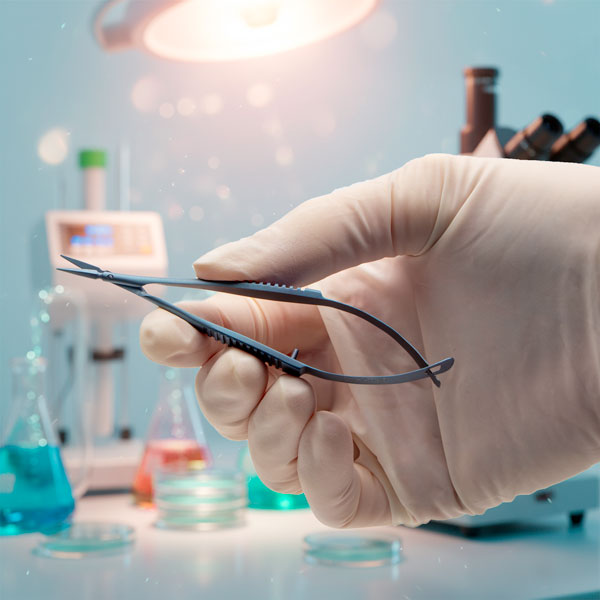
Needle holders, also known as a needle drivers. They are used in wound closure, ligation, reanastomosis and other surgical procedures which require suturing. The needle is usually held in position by a clamp mechanism, which allows the operator to manipulate the needle through various tissues. The jaws are generally textured and short in comparison to the shank to retain a solid grasp on the needle.
- - April 19, 2022
ATC2000 is a low noise heating system for maintaining animal body temperature during experimental procedures. Here we will look at the main display on the front panel to see what information is available and the three operational modes.
The main display window shows the set point and the mode of operation on the left side of the screen. On the right side, the control temperature and plate temperature are visible. The arrow next to the TC Probe indicates that the TC Probe is the controlled temperature.
TEMPERATURE DISPLAY
In this illustration, the unit is controlling the thermocouple (TC) probe. In this case, the RTD probe temperature can be viewed by pressing the Display button. When the unit controls the RTD probe, that temperature displays on this screen. The OK next to a temperature indicates that the temperature falls within the parameters defined by the low and high alarm limits. If the temperature falls below the low limit, LO displays instead of OK. Likewise, if it exceeds the high...more

Recent Posts