Page 19 - Blog
- - August 05, 2022
The ATC2000 is a low noise heating system for maintaining animal body temperature during expirimental procedures. Here we show you how to use the adaptive mode on the ATC2000 system.
- Press the Config button to access the configuration menu. Press the Config button again until the adaptive mode Enable displays.
NOTE: If the temperature source is set to heater plate, then the adaptive mode cannot be enabled.
2. Press the Up or Down button to enable or disable adaptive mode.
3. Press the Display button to save the new parameters or press the Config button to toggle through the rest of the parameters.
Once the adaptive mode is enabled, Adaptive appears as the mode on the main display window. If you press the Display button again, the alternate temperature displays along with a timer that counts up from the last sampled time. In this case, the temperature was sampled 5 minutes and 42 seconds ago. If the interval is set to 10 minutes, the temperature will be sampled again in...more
- - July 19, 2022
EVOM™ Manual is WPI's newest instrument to measure Trans Epithelial Electrical Resistance (TEER). Let's look at what comes with the system and how easy it is to setup.
- - July 19, 2022
WPI's EVOM system is popular in the research community, both in academia and in industry, and it is commonly used for the evaluation of mammalian cellular health by measuring transepithelial/transendothelial electrical resistance (TEER or TER) of cellular layers.
EVOM™ Manual is powered by the same EVOM™ technology as older EVOM models (EVOMX, EVOM, EVOM2 and EVOM3). It has advanced features for performing experiments more easily. With the new touchscreen display you can now store data as Microsoft® Excel files on a USB flash drive. Just remove the flash drive with all your recorded data from the EVOM™ Manual and plug it into a computer to access and plot your data. It is as simple as it sounds.
- - July 13, 2022
EVOM™ Manual is WPI’s newest instrument to measure Trans Epithelial Electrical Resistance (TEER). Let’s look at how to set it up and take voltage measurements.
- Power on the EVOM™ Manual using the power switch on the rear panel.
- Insert the USB flash drive provided with the system into the USB port on the side of the meter.
- By default, the filename is plate1. You may choose a prefix that auto-indexes or a unique file name:
- Press and hold the Store button on the main screen for 2 seconds or press Store Screen on the Setup menu to configure your stored data files.
- To use a prefix and auto-indexing, activate the Auto Index radio button. Auto indexing sets the name to a numeric sequence with the name, a prefix and a sequential number (name_prefixN). Then, press Store Prefix to enter a file name. Or, to use a unique file name, deactivate the Auto Index radio button. Then, select File Name to enter a new name.
- Press Clear.
- Use the keypad to enter a new name.
- Press Enter.
- Press Setup to access...more
- - July 12, 2022
WPI’s EVOM™ technology is the gold standard for delivering stable and repeatable Trans Epithelial Electrical Resistance (TEER) measurements. Here are nine reasons to trust the new EVOM Manual TEER Meter for qualitatively measuring cell monolayer health and quantitatively measuring cell confluence.
- - July 11, 2022
EVOM™ Manual is WPI’s newest instrument to measure Trans Epithelial Electrical Resistance (TEER). Let’s look at how to set it up and take resistance measurements.
Power on the EVOM™ Manual using the power switch on the rear panel.
Insert the USB flash drive provided with the system into the USB port on the side of the meter.
By default, the filename is plate1. You may choose a prefix that auto-indexes or a unique file name:
- Press and hold the Store button on the main screen for 2 seconds or press Store Screen on the Setup menu to configure your stored data files.
- To use a prefix and auto-indexing, activate the Auto Index radio button. Auto indexing sets the name to a numeric sequence with the name, a prefix and a sequential number (name_prefixN). Then, press Store Prefix to enter a file name. Or, to use a unique file name, deactivate the Auto Index radio button. Then, select File Name to enter a new name.
- Clear.
- Use the keypad to enter a new name.
- Press Enter.
Press Setup to access...more
- - June 15, 2022
WPI carries a wide variety of fluid handling tools utilizing different technologies: - Microinjectors
- Peristaltic pumps
- Syringe pumps
- Pneumatic injectors
The range of applications and the criteria used to select a particular pump or injector is broad and complex, and we encourage you to call us at (866) 606-1974 or email customerservice@wpiinc.com and speak with an application specialist. In the meantime, here is a listing of our popular pumps and injectors sorted by technology, flow range and special features.
Special features tell you about applications or functionsof the pump. Many of the syringe pumps can be had with an alarm option that alerts you to the end of travel or blocked flow. The onew with the “P” option allow for programmable flow and volume profiles without using the RS232 computer interface.
Frequently used terms:
- Infuse/Withdraw (I/W): Describes a feature of a syringe pump whereby the syringe plunger is held by the pusher so the motor can pull the plunger back, withdrawing...more
- - June 05, 2022
WPI offers a variety of scissors which are widely used in healthcare units, hospitals and laboratories. Most scissors have ring handles.
Let's take a look at the the anatomy of a standard pair of scissors.
Cutting edge lengths are measured as the operational length of the cutting edge, the operational blade length. The cutting edge length on standard scissors is a little subjective, depending on the hand size of the operator. Open the scissors to a normal, natural position, and measure the distance from the tip to where the two blades cross. This is the maximum the jaws will open without unnatural manipulation. The blade length is a little longer and is measured from the hinge to the tip of the blade. The blade length corresponds with the depth of the incision you wish to make. The smaller sized blades are used at the surface for small incisions, and the longer blades go deeper into cavities.
The hinge is the point where the two blades connect. It may have a tension screw, which...more
- - May 30, 2022
WPI’s EVOM™ Manual is the gold standard for delivering stable and repeatable Trans Epithelial Electrical Resistance (TEER) measurements. The EVOM™ Manual qualitatively measures cell monolayer health and quantitatively measures cell confluence by determining an increase or a plateau in tissue resistance detected using our innovative EVOM™ technology. The main display window has lots of information. Here’s a quick overview. You can download the infographic for a handy reference.
- - May 25, 2022
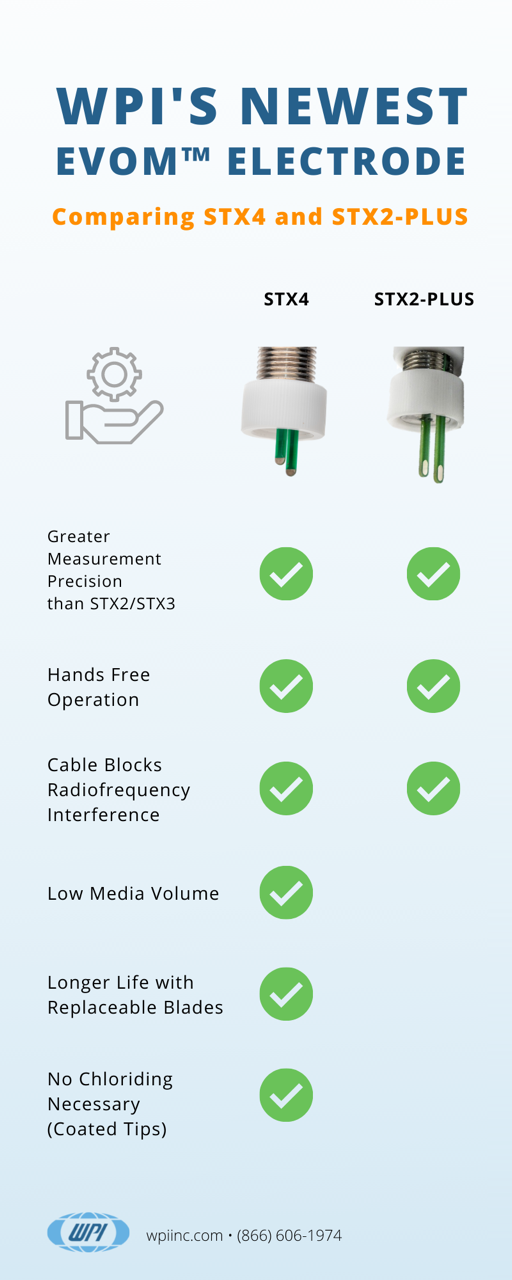
As WPI’s EVOM™ line of TEER/TER (Transepithelial Electrical Resistance) measurement meters continues to evolve, we have seen similar advancements in the design of its electrodes. The new STX4 electrode (EVM-EL-03-03-01) (LINK) offers many advantages over the STX2-PLUS released in 2020. Both the STX4 and the STX2-PLUS are improvements on the STX2 and STX3 designs used with the EVOM, EVOMX, MilliCell® ERS and ERS2, and EVOM2. In this article we will compare the two newest designs.
Dowload the Comparison Chart
The advanced design of both the STX4 and the STX2-PLUS offer greater measurement precision and a better user experience. In part this is due to the stable design of the weighted, self-standing electrode. The electrode is keyed to the 24-well plates. This ensures repeatable placement that gives more consistent results, eliminating the need for multiple readings.
Both are also designed for hands-free operation. When properly positioned, the electrode will stand on its own in a single...more

Recent Posts